Home / Introduction to TOC
Free resource
Introduction to the Theory of Constraints
Why the weakest link limits the whole chain, why it is called a theory, and the Five Focusing Steps managers use to improve continuously.
What is Theory of Constraints?
In the early 1980s, an Israeli physicist, Dr. Eli Goldratt, started applying the mindsets and methods of the hard sciences to the "soft" science of analyzing, improving and managing organizations.
Scientists search for inherent simplicity: simple mechanisms or governing laws that explain complex phenomena. Goldratt realized there was also inherent simplicity within complex organizations.
In the same way that the weakest link in a chain limits the strength of the whole chain, the performance of any organization is limited by its system constraint or bottleneck.
He called his discovery and the related body of knowledge Theory of Constraints, or TOC.
But why call it a theory?
Dr. Kurt Lewin (1890 to 1947), ONE of the pioneers in psychology, famously said that "There is nothing so practical as a good theory."
In science, a theory, as in the Theory of Relativity or the Theory of Evolution, is simply a good and useful explanation of why a certain phenomenon exists, and why it is important or useful to know this.
Theory of Constraints, as a management theory, is a good and useful explanation of why it is very useful to know the constraint of any system. That matters most to managers who have to make reliable commitments and take decisions in an environment with high levels of Volatility, Uncertainty, Complexity, Constraints and Ambiguity (VUCCA).
Knowing that the constraint limits the performance of the whole organization helps us:
- set ambitious but achievable targets,
- judge the impact of local changes on the system as a whole,
- decide where to focus management attention,
- decide which rules achieve global rather than local optima, and when to change the rules.
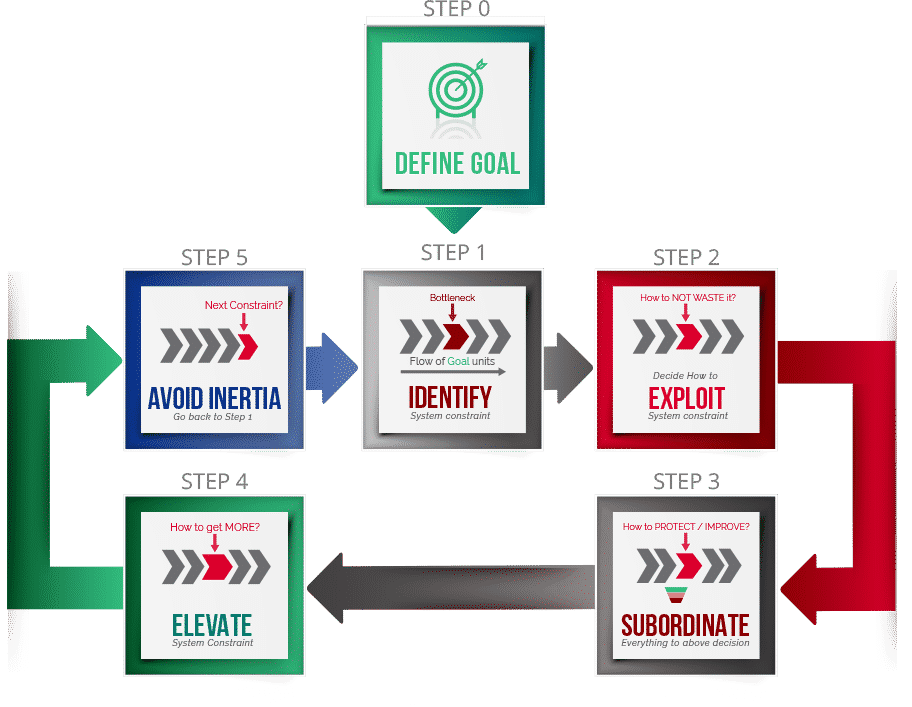
Dr. Goldratt turned these into a practical focusing mechanism for a process of ongoing improvement. He called it the Five Focusing Steps (5FS).
Theory of Constraints
The Five Focusing Steps
- 1
Step 1: IDENTIFY the system constraint
Find what limits the organization from achieving more of its goal units.
- 2
Step 2: Decide how to EXPLOIT the constraint
Do not waste it. Close the gap between the theoretical maximum and the average level of constraint exploitation.
- 3
Step 3: SUBORDINATE everything to that decision
Change only those rules and metrics that conflict with the decision in step 2.
- 4
Step 4: ELEVATE the system constraint
When exploiting is not enough, add capacity at the constraint.
- 5
Step 5: GO BACK TO STEP 1
If in a previous step a constraint was broken, do not let inertia become the system constraint.
A body of knowledge built on five steps
Dr. Eli Goldratt, together with a group of TOC practitioners, created a vast body of knowledge on how to apply the Five Focusing Steps to different types of organizations and to different parts of the organization: operations, finance, supply chain, projects, sales, marketing and managing people.
He also developed a holistic decision support framework, Throughput Accounting, and a set of logical Thinking Processes for when organizations get stuck on ONE or more of the five steps.
To achieve step 3, TOC solutions offer managers simple rules for planning, execution and continuous improvement, including Drum-Buffer-Rope for operations, Demand Driven Replenishment for distribution and Critical Chain Project Management for projects.
A large part of this body of knowledge is captured in the five generic Strategy and Tactic Trees in the Goldratt S&T Library of HARMONY.